table of contents
Your security team handles alerts around the clock, but breaches still slip through. Internal resources stretch thin as threats grow smarter with AI in 2026. You need a managed security service provider that fits your operations without adding risks.
Many organizations pick MSSPs based on flashy demos or low bids. That approach often leads to gaps in coverage or poor response times. This guide gives you a practical framework to evaluate providers so you select one that boosts your defenses.
Let’s start with a clear process to assess candidates.
Build Your Internal Requirements First
Define your needs before contacting vendors. List your environment: cloud setups, on-premises servers, endpoints, and key apps. Note compliance rules like NIST 2.0 or CMMC 2.0 updates that apply to your industry.
Consider your gaps. Do you lack 24/7 eyes on logs? Need faster threat hunting? Document maturity levels now. A 2026 study shows 88% of teams save time with AI detection, so prioritize providers that integrate it.
Assign a cross-functional team: IT, security, procurement, and legal. They review proposals together. This prevents silos and ensures buy-in.
Set benchmarks early. Aim for mean time to detect (MTTD) under 4 hours and mean time to respond (MTTR) under 6 hours for high-priority incidents. Providers should beat industry averages.
Once requirements sit clear, issue a request for information (RFI). Use it to narrow the field from 20 to five contenders.
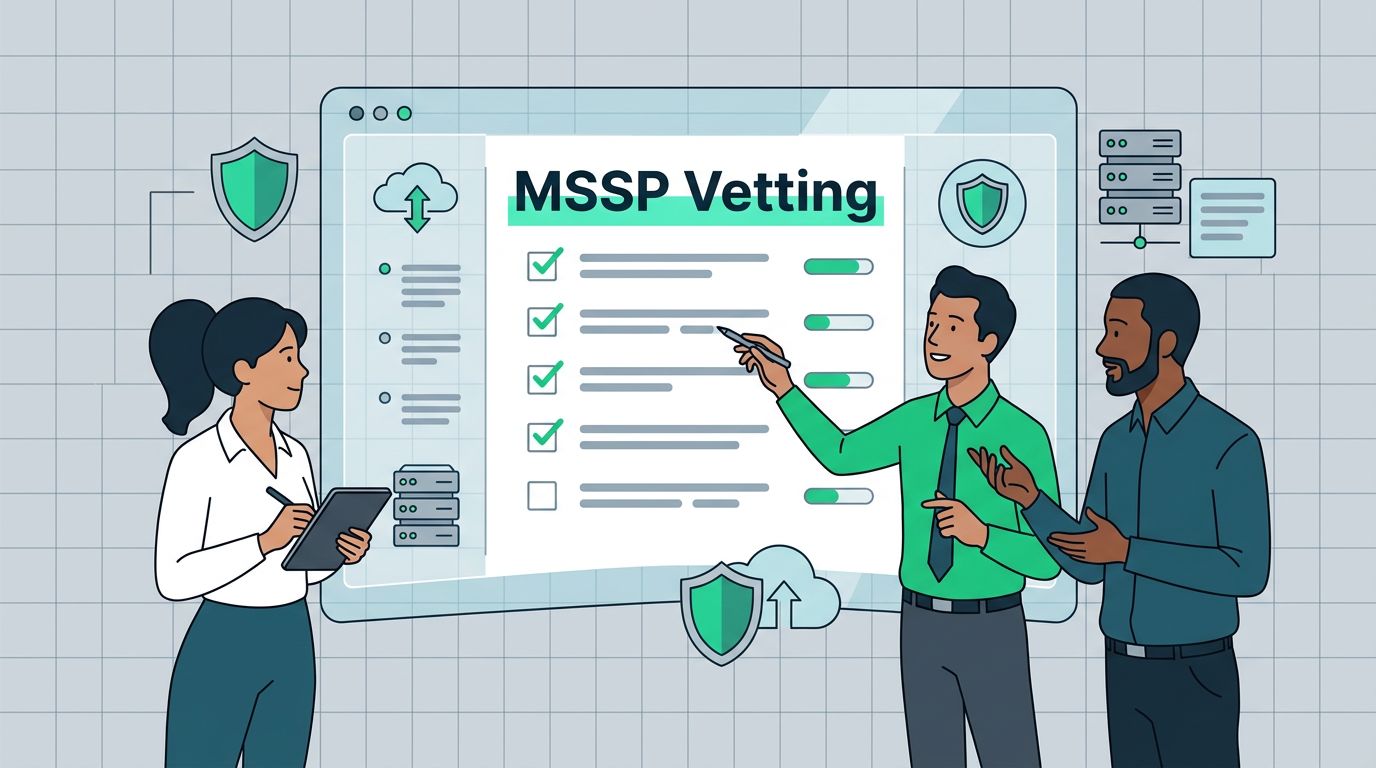
Step-by-Step Vetting Framework
Follow this six-step process to compare MSSPs systematically. It cuts through sales talk and focuses on proof.
Step 1: Shortlist based on RFI responses. Score on coverage, experience, and pricing outline. Eliminate those without your industry references.
Step 2: Request for proposal (RFP). Detail SLAs, tech stack, and onboarding timeline. Ask for anonymized incident reports.
Step 3: Reference checks. Contact three clients similar to you. Probe real incidents, not demos.
Step 4: Technical demos and POCs. Run a 30-day proof of concept (POC) with your logs. Measure alert quality and response.
Step 5: Contract review. Scrutinize SLAs, exit clauses, and data ownership.
Step 6: Final negotiation and kickoff. Lock in custom terms before signing.

This framework works because it tests in your environment. For example, one mid-market firm used it to spot a provider’s weak cloud log ingestion during POC. They switched and cut MTTD by half.
Expect the full process to take 60-90 days. Rush it, and you risk mismatches.
Essential Questions to Ask MSSPs
Probe deeply during calls and RFPs. Good answers show maturity; vague ones signal trouble.
Start with operations:
- How do you handle 24/7 monitoring? Do analysts rotate shifts, or do you use offshore teams?
- What is your MTTD and MTTR from the last 12 months? Provide data by severity.
- Describe your escalation procedures for P1 incidents.
Move to tech:
- Which log sources do you cover out of the box? Multi-cloud, SaaS, OT?
- How do you integrate XDR for endpoint, network, and cloud?
- Explain your AI use in threat detection. Share false positive reduction stats.
On compliance:
- Which frameworks do you support? NIST 2.0, CMMC 2.0, SOC 2 Type II?
- How do you help with audits? Sample reports?
Finally, people and process:
- Walk us through onboarding. Timeline and steps?
- How do you report? Daily digests or executive dashboards?

Use this table to score responses:
| Category | Key Question Example | Strong Answer Traits | Score (1-5) |
|---|---|---|---|
| Monitoring | Log source coverage? | Lists 50+ sources, custom ingest | |
| Threat Response | MTTD/MTTR benchmarks? | <4h detect, <6h respond, data-backed | |
| Compliance | Audit support? | SOC 2 reports, framework mappings | |
| Onboarding | Timeline? | 30-60 days, asset discovery first |
Top scorers advance. See MSSP evaluation checklist from MSSPProviders.io for more benchmarks.
Evaluate Core Capabilities
Test these areas hands-on. Demos reveal true fit.
24/7 Monitoring and Coverage
Expect global SOCs with tiered analysts. U.S.-based for sensitive data. Coverage should span endpoints, networks, cloud (AWS, Azure), email, and SaaS like O365.
Log source count matters less than ingestion speed. Top providers handle 100+ sources in days. In 2026, XDR unifies it all, cutting blind spots.
Threat Detection and Response
AI flags anomalies fast. Ask for playbook libraries: ransomware isolation, credential revocation. Human override stays key.
SLAs must specify time-to-first-contact under 15 minutes for critical alerts. False positive rates below 20% after tuning.
Escalation and Onboarding Procedures
Clear chains: analyst to lead to your CISO. Test in POC.
Onboarding takes 30-90 days. Steps include asset inventory, baseline alerts, rule tuning, and dry-run incidents. Rushed setups fail.
For details on SLAs, check CyberReplay’s MSSP checklist.
Spot Common Red Flags Early
Skip providers with these issues. They predict poor service.
Vague SLAs like “best effort” lack teeth. Demand numeric commitments with credits for misses.
No industry references? Pass. They miss your threats.
Weak onboarding promises: “Live in a week” means skipped tuning.
Subcontracted response teams hide risks. Insist on in-house.
High alert noise without tuning plans. Good MSSPs reduce it 20% yearly.
Rip-and-replace demands signal inflexibility.

References confirm red flags. Ask: “Did they meet SLAs in crises?” Hesitation means trouble. Ekfrazo’s MSSP buyer’s guide lists more disqualifiers.
Pricing and ROI Considerations
Pricing hides traps. Expect $50-150 per endpoint monthly, plus setup fees. Tiered models fit SMBs to mid-market.
Demand transparency: Break out monitoring, response, compliance. No hidden overage charges.
Compare ROI: Calculate risk reduction. A provider cutting MTTR by 50% saves breach costs.
Weigh SLAs against price. Cheap lacks enforcement.

| Factor | What to Negotiate | ROI Impact |
|---|---|---|
| Base Fee | Per asset/device | Scales with growth |
| SLA Credits | 10-20% for misses | Enforces performance |
| Exit Fees | None after year 1 | Flexibility |
| Reporting | Custom dashboards | Proves value quarterly |
In 2026, insurers demand MSSP proof for coverage. Strong ROI shows in faster compliance.
Conclusion
Vetting managed security service providers boils down to proof over promises. Use the framework, questions, and criteria to pick a partner that matches your risks and scales with growth.
Strong MSSPs deliver 24/7 vigilance, quick responses, and clear value. Your choice strengthens defenses and frees your team.
Need help sourcing security talent or advisory? Book a Discovery Call with Bud Consulting to discuss your MSSP fit.