table of contents
Your security team manages dozens of tools. Alerts pile up from SIEM, EDR, CNAPP, and more. You pay for licenses, but response times lag and coverage feels spotty. Security tool overlaps waste money and slow you down.
In 2026, budgets tighten while threats grow. Platform consolidation around XDR and CNAPP cuts sprawl. AI handles routine ops, but licensing rules add scrutiny. You need to spot true redundancies, not just trim blindly.
This guide walks you through an audit. You’ll build a framework to separate healthy layers from waste. Start today to boost ROI.
Why Security Tool Overlaps Hurt in 2026
Teams add tools fast. A new cloud risk means another scanner. An audit flags gaps, so you grab endpoint protection. Soon, you have 50+ products. Each pulls data, generates noise, and demands tuning.
Overlaps create chaos. SIEM catches logs that EDR duplicates. CNAPP scans workloads already covered by vuln tools. Analysts switch dashboards, missing context. Response slows. One report shows 37% of teams prioritize unified views for this reason.
Costs stack up too. Licenses run high with AI features. EU AI Act demands audits on high-risk tools by August. Shadow AI skips compliance, but it risks fines. Breaches from fatigue hit harder; average cost climbs yearly.
Consolidation fixes this. XDR merges detection across endpoints, networks, cloud. CNAPP unifies posture and runtime protection. Gartner notes unified stacks cut breaches. Yet, you must audit first. Blind cuts drop coverage.
Recent mergers like Cisco-Splunk push this. Check your contracts; support shifts. Focus on outcomes: fewer alerts, faster fixes. Smart leaders inventory now.
Spot the Signs of Tool Overlaps
Look for patterns in your stack. Alerts flood from similar events. One tool flags “critical” malware; another calls it “medium.” Analysts ignore half because they triage by gut.
Usage tells more. Tools sit idle if overlaps exist. Pull logs: does your vuln scanner run daily, or does CNAPP handle it? Check dashboards. Multiple views of the same assets scream duplication.
Alert fatigue hits hard. Overlaps mean duplicate signals. A Secure.com article on tool sprawl explains how varying severity scores confuse teams. What SIEM misses, EDR duplicates elsewhere.
Ownership blurs too. Who tunes the network monitor? Cloud team or SOC? Gaps form when no one owns overlaps.
In multi-cloud setups, this worsens. Edge tools duplicate CNAPP runtime checks. Licensing bites: pay twice for identity analytics in UEBA and XDR.

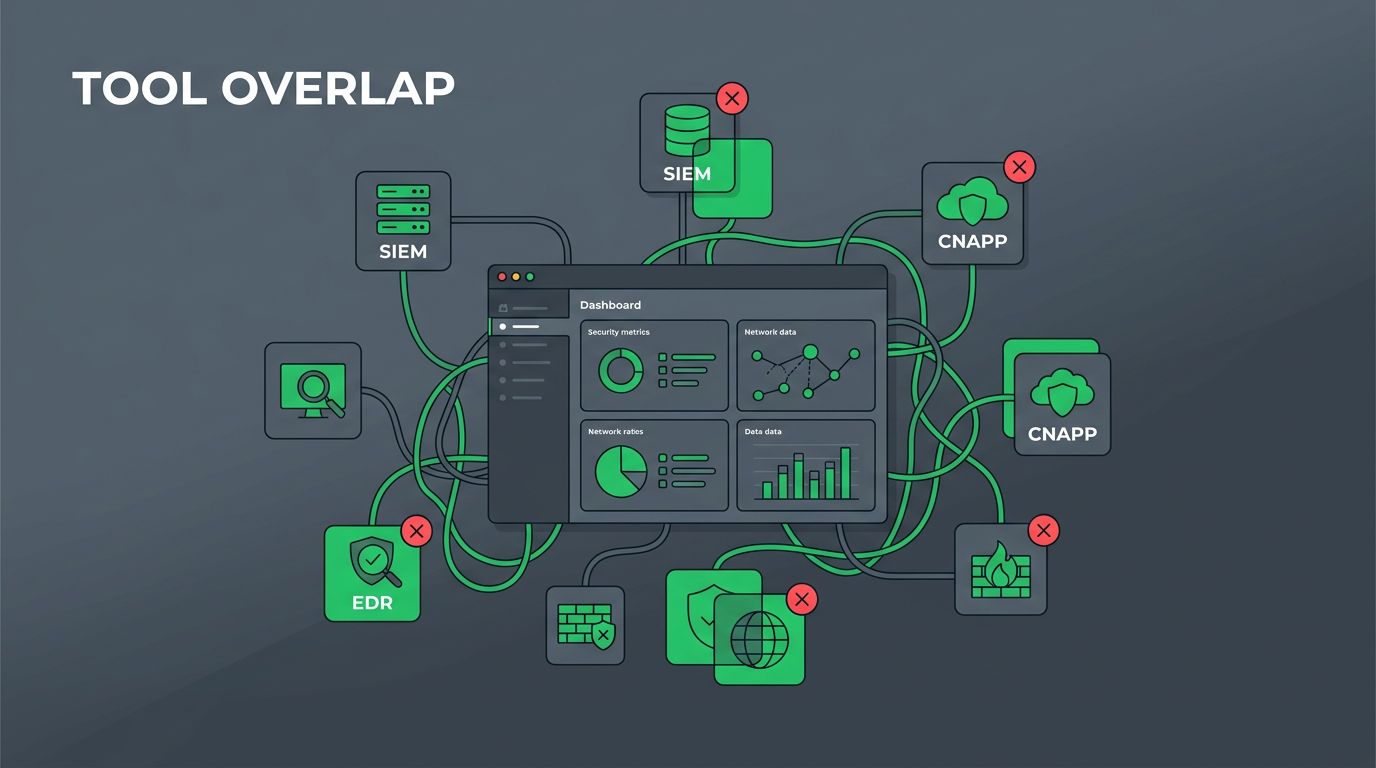
This image shows overlaps glow in a SecOps room. Your stack likely mirrors it.
Distinguish defense-in-depth. Layers add resilience if they complement: SIEM for correlation, EDR for response. Overlaps fail when both just detect the same vuln.
Step-by-Step Guide to Auditing Your Tools
Start with inventory. List every tool. Note owner, license cost, data sources. Include IT, DevOps, cloud teams; security doesn’t own all.
Map capabilities next. For each, jot functions: detection, response, reporting. Group by category like endpoint, identity, cloud.
Spot overlaps. Compare matrices. Does EDR behavioral analytics match SIEM UEBA? Flag if coverage exceeds 70%.
Score them. Weigh integration, usage, cost. High overlap plus low use equals cut candidate.
Test consolidation. Pilot one merge. Migrate alerts to XDR; measure MTTR before and after.
Document gaps. Overlaps hide blind spots. Ensure cuts keep coverage.
A State of Security post suggests usage matrices. Track weekly logins, alert volume.
In 2026, factor AI ops. Tools with agentic AI score higher; they automate triage.

This workflow on screen guides your audit.
Evaluation Frameworks and Scoring
Build a matrix. Rows: your tools. Columns: coverage, overlap risk, cost, integration, ROI.
Score 1-10. Coverage: asset visibility breadth. Overlap: percent shared functions. Cost: annual spend plus ops time. Integration: API maturity, data normalization. ROI: alerts reduced, MTTR gain.
Weight factors. Budget scrutiny means cost at 30%. AI-assisted ops? Boost integration score.
Here’s a sample matrix. Adapt it in a spreadsheet.
| Tool | Coverage (1-10) | Overlap Risk (1-10) | Annual Cost | Integration (1-10) | Total Score |
|---|---|---|---|---|---|
| SIEM | 9 | 7 | $150K | 8 | 7.2 |
| EDR | 8 | 8 | $80K | 9 | 7.5 |
| CNAPP | 10 | 6 | $120K | 10 | 8.8 |
| Vuln Scanner | 7 | 9 | $40K | 5 | 5.1 |
CNAPP wins here; it absorbs scanner duties. Total score averages weighted columns.
An Estes Group blog stresses governance post-audit. Assign owners per category.
For XDR/CNAPP, check telemetry unification. TBD Cyber’s optimization page maps convergence.

Use this matrix view to score fast.
Common Pitfalls to Avoid
Don’t cut by cost alone. Cheap tools fill gaps; assess coverage first.
Vendor lock traps you. Test data export before dropping a tool.
Ignore licensing shifts. AI features trigger new compliance; EU rules hit soon.
Overlook teams. DevOps loves their scanner; consolidate with buy-in.
Blind to sprawl evolution. Cloud expands CNAPP needs; re-audit quarterly.
A Medium post on tool overload lists top redundants: unused alerts, misconfigs.
Measure post-change. Track fatigue, costs. Adjust if MTTR rises.
Conclusion
Audit overlaps to reclaim control. Inventory, map, score, consolidate. Unified XDR or CNAPP platforms deliver in 2026’s AI-driven ops.
You distinguish depth from waste. Budgets approve ROI-focused stacks. Teams respond faster.
Ready for help? Book a Discovery Call with Bud Consulting to review your stack. Act now; sprawl costs breaches.