table of contents
Insider threats hit close to home. They come from people with legitimate access, so they slip past perimeter defenses. In 2026, with hybrid work and SaaS apps everywhere, these risks spike; 74% of organizations report more incidents, and most stem from negligence rather than malice.
You manage SOC teams or risk programs. You know alerts pile up, but without clear playbooks, responses lag. The average cost per incident tops $19.5 million, and containment takes 67 days on average. Good news: structured insider threat detection playbooks cut that time and damage.
This guide walks you through a vendor-neutral framework. You’ll get sample components, checklists, and workflows tailored to cloud-heavy, privacy-focused setups. Start building yours today.
Understand Types of Insider Threats
Know your adversaries first. Insider threats fall into three buckets: malicious intent, negligence, and credential compromise. Each needs different detection triggers.
Malicious insiders act with purpose. They steal data for profit or revenge. Think an employee copying customer lists to a personal drive before quitting. In hybrid setups, they exploit SaaS shares or cloud storage.
Negligent users cause most breaches, about 55%. They fall for phishing or misconfigure permissions. A remote worker might upload sensitive files to an unapproved cloud folder by mistake.
Compromised credentials round it out. Attackers use stolen logins from infostealers. Recent cases like the Vercel breach in April 2026 show how malware at a third-party AI SaaS led to OAuth token theft and lateral movement.
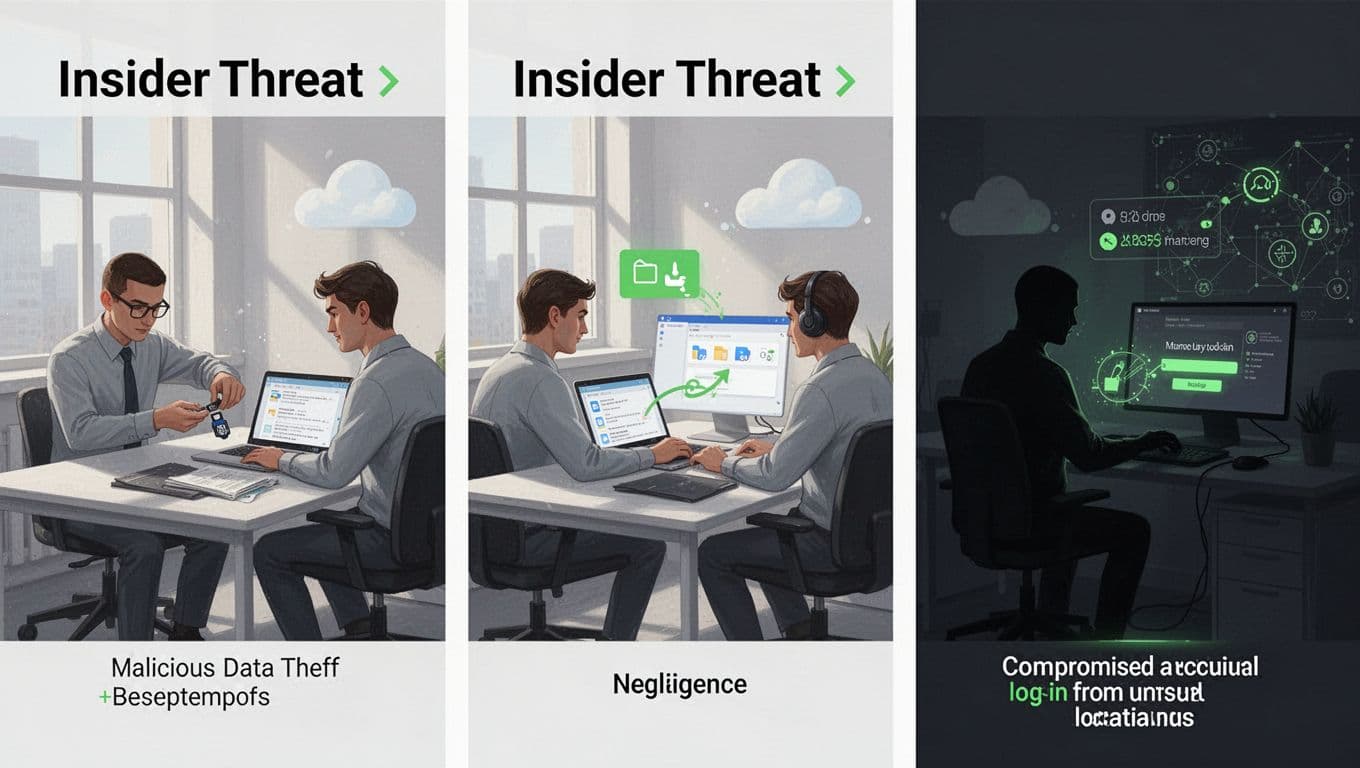
Distinguish them in your playbooks. Malicious acts show patterned behavior, like bulk downloads at odd hours. Negligence triggers on one-offs, such as mass email forwards. Compromises flag impossible travel, like logins from two countries in minutes.
Use this table to map indicators:
| Threat Type | Key Behaviors | Common Environments |
|---|---|---|
| Malicious | Bulk exfiltration, privilege escalation | SaaS exports, cloud buckets |
| Negligent | Accidental shares, weak passwords | Hybrid VPN, email chains |
| Compromised | Anomalous logins, rapid actions | Stolen creds via infostealers |
Baseline normal activity per role. Then set thresholds. For sales reps, flag downloads over 1GB. Engineers get leeway on code repos but not HR files.
Recent stats back this. AI detects 89% more threats, but only if tuned to these types. External monitoring adds context, like job sites or financial stress signals from public data.
Assess Your Current Environment
Map your attack surface before playbook design. Hybrid work blurs lines between office, home, and cloud.
List assets. Inventory SaaS apps, cloud tenants, endpoints, and IAM systems. In 2026, average firms run 200+ SaaS tools; gaps here breed risks.
Check visibility. Do you log cloud activity? Hybrid setups demand tools that span Entra ID, Okta, and AWS. Note blind spots, like shadow AI where staff feed data to unvetted LLMs.
Run a risk assessment. Score users by access level and sensitivity. High-risk groups include finance, HR, and departing employees.
Here’s a quick checklist:
- Identify top data stores (e.g., Salesforce, Google Workspace).
- Review logging coverage (95% minimum for UEBA).
- Audit permissions quarterly.
- Baseline peer groups (e.g., devs vs. managers).
Privacy matters too. SEC rules require disclosure within four business days for material incidents. EU regs add consent for monitoring. Build in least-privilege logging.
Test with purple team exercises. Simulate a negligent share in your SaaS stack. Time detection to response. Gaps show where playbooks must focus.
This step takes a week but saves months later. Firms with continuous monitoring catch threats pre-damage.
Build Your Detection Framework
Start with a core structure. Your playbook follows detect, investigate, respond. Make it modular for different threats.
Define triggers. Use UEBA for baselines. Flag deviations like logins outside 9-5 or access to off-role folders.
Create scenarios. Prioritize top risks:
- Data exfiltration via cloud sync.
- Privilege abuse in SaaS.
- Anomalous hybrid logins.
Document each. For exfiltration: Monitor egress to personal clouds. Threshold: 500MB/hour outside norms.

Build a sample workflow:
- Monitor: UEBA scans logs hourly.
- Alert: Score hits 8/10; notify tier 1.
- Triage: Check context (vacation? New hire?).
- Escalate: If confirmed, isolate user.
For Rippling’s insider threat playbook, they emphasize NIST-aligned steps. Adapt that: Start with low-risk coaching, escalate to isolation.
Incorporate hybrid realities. Track VPN drops or home IP spikes. SaaS needs API polling for shares.
Set SLAs. Tier 1 alerts in 5 minutes; investigations under 30. Use scorecards for metrics.
This framework scales. Update quarterly with new intel, like 2026’s AI agent risks from long-lived API keys.
Integrate Detection Tools
Tools amplify playbooks. Focus on UEBA, SIEM, SOAR in cloud-native stacks.
UEBA baselines users and entities. It spots peers: Why did Bob download 10x normal files?
Feed into SIEM for correlation. SIEM aggregates logs from hybrid sources. Add SOAR for automation.

Pick integrations wisely. Splunk’s native UEBA in Enterprise Security unifies SIEM/SOAR for end-to-end response. Exabeam pairs UEBA with SOAR playbooks.
Sample integration playbook:
| Tool | Role in Playbook | Key Feeds |
|---|---|---|
| UEBA | Anomaly scoring | User logs, cloud APIs |
| SIEM | Alert correlation | All endpoints/SaaS |
| SOAR | Auto-containment | Risk scores >7 |
Configure rules. For negligence: Alert on public link shares. Malicious: Chain with external recon.
Cloud monitoring covers IaaS/SaaS. Guard rails prevent overreach; anonymize PII in logs.
70% of AI users report faster responses. Test feeds end-to-end. False positives drop 50% with tuning.
Vendor-neutral tip: Define data models first. Then select tools.
Develop Response Workflows
Detection means nothing without response. Automate where safe; humans for nuance.
Tier responses by severity. Low: Email nudge. Medium: Manager notify. High: Account freeze.
Sample negligent user flow:
- Alert on mass share.
- SOAR pulls context (file type, destination).
- Auto-quarantine link.
- Notify user: “Revoke and retrain.”
For malicious: Isolate endpoint, forensic snapshot, law enforcement handoff.
Hybrid tweaks: Remote wipe via MDM. SaaS: Revoke sessions.
Document gotchas. Privacy: Log consents. Compliance: SEC timelines.
Use structured triage from Nisos best practices. Combine signals: Behavior plus external intel.
Dashboards track open cases. Leaders see MTTR daily.
Automate 80% of tier 1. Humans focus on high-value.
Test and Refine Playbooks
Playbooks rot without tests. Run quarterly simulations.
Purple team it. Simulate compromise: Fake anomalous login from abroad.
Measure: Detection time, alert accuracy, response efficacy.

Refinement checklist:
- Review false positives (tune thresholds).
- Update for new threats (e.g., AI data leaks).
- Audit integrations (UEBA-SIEM flow).
- Train SOC (tabletop every quarter).
Post-Match Group breach lessons: Test SaaS chains. Stryker wipeout stressed real-time response.
Track metrics: 54% use AI for this now. Aim for 90% automation coverage.
Iterate fast. Monthly reviews beat annual overhauls.
Handle Compliance and Privacy
Playbooks must respect regs. 2026 amps scrutiny.
SEC mandates four-day disclosures. States pile on with data laws.
Bake in: Anonymized monitoring, audit trails, DPO reviews.
For EU: DPIA before UEBA rollout.
Sample clause: “Correlate only aggregated data; PII touch requires approval.”
External intel? Stick to public sources.
Balance scales risk reduction without chilling effects.
Conclusion
Strong insider threat detection playbooks turn chaos into control. You now have a framework: Assess, build, integrate, respond, test, comply.
Focus on types, hybrid SaaS realities, and tool chains like UEBA-SIEM-SOAR. Simulations keep them sharp.
Start small: One scenario this week. Scale from there. Your SOC will respond faster, costs drop, and risks shrink.
Need talent for implementation? Book a Discovery Call with Bud Consulting to close skills gaps.
(Word count: 2487)