table of contents
An insider threat rarely begins with a single alarming event. More often, insider threat indicators appear as small changes in access, data handling, or workplace behavior.
A late-night login may be legitimate. A large download may support an approved project. A frustrated employee may need support, not investigation. Security teams need context, documented policy, and evidence before treating any signal as a security incident.
What Counts as an Insider Threat Indicator?
An insider threat involves a person who uses authorized access, knowledge, or relationships to harm an organization. The person may be an employee, contractor, partner, former employee, or service provider. The activity may be intentional, accidental, negligent, or influenced by an external party.
The CISA definition of insider threats focuses on the misuse of authorized access or organizational knowledge. That matters because standard perimeter controls may not stop someone who already has valid credentials.
Indicators usually fall into three groups:
- Technical signals, such as unusual logins, data transfers, privilege changes, or unauthorized software.
- Behavioral signals, such as hostility, repeated policy violations, or unusual interest in sensitive information.
- Situational signals, such as termination, financial pressure, workplace conflict, or sudden changes in personal circumstances.
No single signal proves malicious intent. A strong insider risk program looks for patterns, combinations, and deviations from an established baseline.
The baseline must reflect the person’s role. A database administrator may regularly access large data sets. A finance employee may download payroll reports. A developer may use repositories and cloud environments that other employees never touch. The same activity can be normal for one role and high risk for another.
This is why access reviews and role-based policies are central to detection. The organization must know what access is expected before it can identify abnormal activity.
Technical Insider Threat Indicators Security Teams Should Monitor
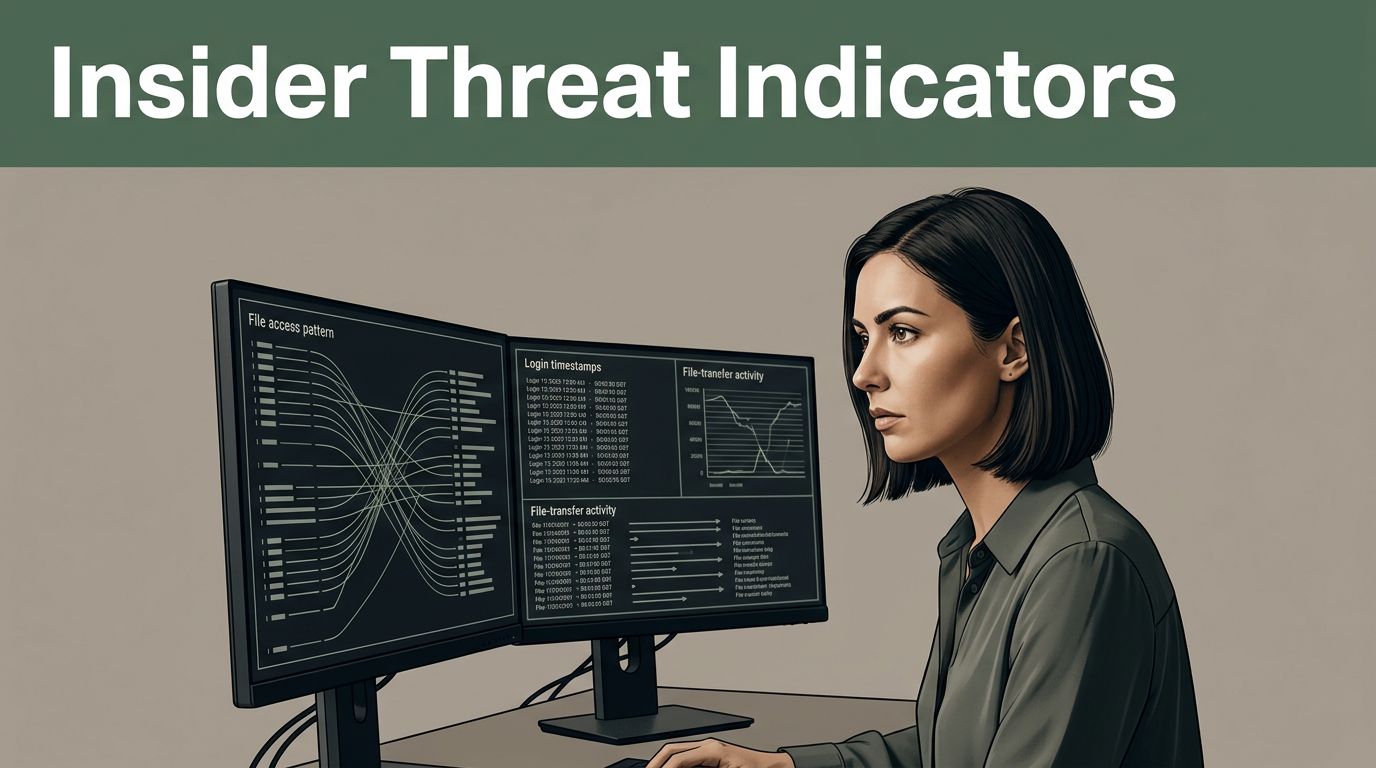
Technical data can provide useful evidence when it is collected lawfully and reviewed against a clear business purpose. Security teams should monitor identity, endpoint, cloud, email, network, and data access events.
Common technical insider threat indicators include:
- Logins at unusual times or from locations that do not match the employee’s normal work pattern.
- Access to systems, repositories, or records outside the person’s approved duties.
- Attempts to access restricted information without a business need.
- Large or unusual downloads, uploads, print jobs, or file copies.
- Use of unauthorized USB devices, personal storage, or unapproved transfer tools.
- Installation of non-approved applications or changes to security settings.
- Attempts to disable endpoint protection, firewalls, logging, or other controls.
- Repeated failed access attempts followed by a successful login.
- Privilege escalation requests that lack a documented business reason.
- Data sent to personal email accounts or unauthorized external domains.
- Use of another person’s credentials or evidence of account sharing.
- Remote access while on leave, during illness, or outside approved working arrangements.
The signal is not the event alone. It is the relationship between the event, the user’s role, the timing, the data involved, and the user’s recent activity.
A SIEM or log correlation platform can connect these events. CISA recommends using a log correlation engine or SIEM to monitor and audit employee actions. Identity providers, endpoint detection platforms, data loss prevention tools, cloud audit logs, and email security systems can provide supporting evidence.

A useful detection rule might combine several events. For example, a user accesses a sensitive repository, downloads an unusual volume of files, and transfers data to an external destination shortly before a resignation. That combination deserves review. It still does not prove intent.
A good alert describes a deviation from expected work, not a person’s identity or character.
Security teams should also control the quality of the data. Excessive alerts create fatigue. Poorly defined rules can label normal work as suspicious. Monitoring should focus on sensitive systems, privileged accounts, high-risk data, and events that violate documented policy.
Behavioral and Situational Insider Threat Indicators Need Context
Human behavior can provide useful context, but it requires care. Behavioral observations are not diagnoses. They should never be used to profile people based on protected characteristics, personal beliefs, health conditions, or lawful activity.
Possible indicators include a sudden change in work patterns, repeated hostility, unusual secrecy, unexplained policy violations, or inappropriate interest in information outside the person’s responsibilities. Persistent conflicts, missed deadlines, absenteeism, and abrupt disengagement may also matter when they occur alongside technical anomalies.
Situational conditions can increase risk without proving wrongdoing. These may include a pending termination, serious workplace conflict, financial difficulty, pressure from an outside party, or a change in employment. Security teams should treat these conditions as reasons to review controls and provide support, not as evidence of guilt.
The CISA Insider Threat Mitigation Guide supports a program-based approach. Awareness training, access control, reporting channels, monitoring, and response procedures need to work together.
A manager might report that an employee is asking for access beyond their role. HR might identify an upcoming departure. The SOC might find unusual downloads. Each team holds part of the picture. No team should make a final judgment alone.

Use a neutral reporting standard. Reports should describe observable facts:
- The account accessed a restricted folder at 2:14 a.m.
- The user copied 3,200 files to an unapproved device.
- The employee requested access to customer records outside the assigned project.
- The endpoint generated an alert after a security control was disabled.
Avoid labels such as “disloyal,” “unstable,” or “dangerous.” Those labels add bias and reduce investigative value.
How to Investigate Without Creating a Privacy Problem
An insider threat investigation must protect the organization and the people involved. Monitoring should have a documented purpose, a defined scope, and appropriate approval. Local employment law, privacy rules, labor agreements, and sector requirements may apply.
Before reviewing personal data, confirm the authority for the review. Check the relevant policy, incident response plan, security agreement, and legal guidance. Limit access to investigative records. Record who reviewed the data, what they found, and what decision followed.
The first response is usually preservation and validation. Security teams should preserve relevant logs, confirm timestamps, identify affected systems, and check whether the activity had an approved business purpose. They should also confirm that the account was controlled by the employee and not compromised by malware, credential theft, or session hijacking.
The investigation should answer practical questions:
- What happened, and when did it happen?
- What information or systems were involved?
- Was the access authorized for that role and task?
- Did the activity violate a written policy?
- Are other accounts, devices, or destinations involved?
- What immediate controls can reduce risk without destroying evidence?
Avoid broad searches through unrelated communications or personal information. Review the minimum data required to establish the facts. Use role-based access to case records and retain material only as long as policy or law requires.
HR, legal, security, IT, and management should agree on escalation paths before an incident occurs. Security may recommend suspending a session or rotating credentials. HR may manage the employment process. Legal may advise on evidence handling and notification. Management may approve business continuity decisions.
The CDSE Insider Threat Toolkit provides additional resources for teams building this type of program.
Build a Response Process That Holds Up
A response process should be clear enough to use under pressure. It should also distinguish between accidental exposure, policy noncompliance, compromised accounts, and deliberate misuse.
Start with preventive controls. Apply least privilege. Review privileged access on a defined schedule. Remove access quickly when roles change. Use strong authentication and separate administrative accounts. Restrict removable media where the business does not require it. Define approved cloud services and data transfer methods.
Create a reporting channel that employees can use without fear of automatic punishment. Training should explain what to report, how to report it, and what information helps security validate the concern. CISA recommends regular insider threat awareness training and strict account management practices.
Detection rules should be tested against normal business activity. A rule that alerts on every large download will produce noise in a data-heavy environment. A rule that combines sensitive data access, unusual volume, and an external transfer may provide better prioritization.
Response actions may include:
- Re-authenticating the account and reviewing active sessions.
- Temporarily restricting access to the affected system.
- Preserving endpoint, identity, cloud, and network evidence.
- Confirming the user’s business justification through management.
- Involving HR and legal before employment-related action.
- Notifying affected customers, regulators, or partners when required.
- Restoring normal access after the risk is understood and controls are corrected.
Document the decision. Document the evidence. Document why the response was proportionate.
For organizations that need help defining roles, validating controls, or strengthening security hiring plans, Book A Call With Us.
Conclusion
Insider threat indicators are useful when they lead to disciplined review, not automatic suspicion. Odd-hour access, unusual data movement, unauthorized tools, privilege changes, and sudden workplace changes need context.
The strongest programs combine least-privilege access, reliable logging, clear reporting, privacy-aware monitoring, and coordination among security, HR, legal, and management. Evidence comes before judgment. That standard protects sensitive information while treating employees fairly.