table of contents
Your developers write code every day. One small mistake in memory handling can lead to crashes, data leaks, or full system takeovers. In 2026, with regulators demanding memory safety roadmaps since January, these issues hit harder. Over 70% of CVEs stem from memory safety bugs in C and C++ code.
You need a training program that sticks. It should teach recognition, prevention, and fixes through hands-on work. This article shows you how to build one that delivers results for your team.
Let’s start with why this training can’t wait.
Why Memory Safety Matters Now
Memory safety bugs cause real damage. Attackers exploit them to run arbitrary code or steal sensitive data. CISA and NSA now call them a national security risk. Companies without a memory safety plan face scrutiny from buyers in critical sectors like power grids and transport.
In May 2026, the January roadmap deadline has passed. Firms must show progress: rewrite high-risk code, add tools, and train staff. Buyers ask if components use safe languages. No clear answer means lost deals.
Training fixes this at the source. Developers learn to spot issues early. They adopt habits that block exploits before code ships. Roadmaps demand it; your security posture needs it.

Consider a network service in C++. A buffer overflow lets attackers overwrite stack data. Result? Remote code execution. Training shifts devs from reaction to prevention.
Focus on high-impact areas first. Target network code, crypto modules, and long-running systems. Measure success by fewer bugs in audits. Your team builds reliable software that regulators approve.
Rust adoption grows, but slowly. Companies mix it with C/C++ hardening. Training bridges the gap. It prepares devs for both worlds.
Key Memory Safety Vulnerabilities
Buffer overflows top the list. Code writes past a buffer’s end. Adjacent memory corrupts. In C, strcpy copies without bounds checks. Attackers craft input to overflow and hijack control flow. See OWASP’s buffer overflow guide for details.
Use-after-free follows close. Code accesses freed memory. Another allocation reuses it. The old pointer dangles. Writes corrupt new data; reads leak info. CWE-416 details real examples, like OS kernel flaws.
Null pointer dereferences crash apps. Code assumes a pointer is valid but it’s null. Simple fix: check before use. Yet they persist without training.
Other bugs include double-free and integer overflows leading to bad allocations. They chain into exploits. Devs must recognize patterns in code reviews.
Real-world case: A web server frees a buffer then uses it again. Attacker sends crafted requests. Heap corruption follows. Training uses these to show impact.
Prevention starts with awareness. Teach why bounds checks matter. Show disassembly of buggy code. Devs then rewrite safely.
Incorporate these into sessions. Use vulnerable snippets. Let teams find and fix them. Knowledge turns abstract risks into concrete skills.
Build a Practical Training Program
Start with goals. Aim to cut memory bugs by 50% in six months. Track via static scans pre- and post-training.
Tailor for your stack. C/C++ teams need defensive patterns. Rust groups focus on borrow checker mastery. Mixed teams compare approaches.
Format matters. Mix one-hour workshops with self-paced modules. Run quarterly refreshers. Involve security champs as trainers.
Content outline:
- Week 1: Bug basics and impacts.
- Week 2: Language-specific fixes.
- Week 3: Tools and reviews.
- Week 4: Capstone project.
Assign mentors. Senior devs pair with juniors on fixes. This builds culture.
Budget time. Four hours per dev quarterly. Scale with video recordings for async access.
Partner with experts if needed. For custom needs, book a discovery call with Bud Consulting to plan your program.
Success comes from repetition. Make it part of onboarding. Tie to promotions. Devs prioritize what counts.
Hands-On Exercises That Work
Theory alone fades. Hands-on coding cements skills. Start with buggy C code. Give a buffer overflow example. Devs compile, run, crash it. Then add checks.
Next, use-after-free lab. Allocate, free, access. Watch segfaults. Fix with smart pointers or scopes.
Rust twist: Rewrite the same in Rust. Borrow checker rejects bad code at compile time. Devs see instant feedback.
Group challenges boost engagement. Teams compete to fix most bugs. Use leaderboards.

Incorporate fuzzing early. Feed random inputs to code. Crashes reveal edges. Devs patch and retest.
Cap with a project. Build a mini-server. Introduce bugs. Teams audit, fix, deploy. Measure with tools.
Keep exercises realistic. Pull from your repo. Anonymize real bugs. Devs connect training to work.
Rotate scenarios. One month overflows; next dangling pointers. Variety prevents boredom.
Track participation. Require pull requests with fixes. Reviewers check understanding.
These sessions yield habits. Devs spot issues instinctively.
Essential Tools for Detection
Tools catch what eyes miss. AddressSanitizer (ASan) tops the list. Compile with -fsanitize=address. It detects overflows and use-after-free at runtime. Slows code 2x but finds bugs fast. LLVM docs cover setup.
MemorySanitizer (MSan) tracks uninitialized reads. Pair with ASan for coverage.
Fuzzing automates chaos. LibFuzzer generates inputs. ClusterFuzzLite integrates into CI. Finds crashes pre-merge.
Static analysis scans source. Clang Static Analyzer flags potentials. Integrate into PRs.

Train on workflows. Devs enable sanitizers locally. Run fuzzers on branches. Fail builds on findings.
For Rust, cargo-fuzz or miri simulate UB. No runtime needed.
Mandate in pipelines. Block merges with sanitizer failures. Devs learn by fixing.
Combine tools. Fuzz with sanitizers catches deep bugs. Measure reduction in alerts.
Start small. Pilot on one team. Expand as confidence grows.
Code Review Checklists for Prevention
Reviews block bugs upstream. Use checklists focused on memory.
Core items:
- Bounds checks on arrays, strings.
- Pointer validity before deref.
- Free only once; no dangling refs.
- Smart pointers over raw.
For C++: Prefer std::vector over arrays. RAII everywhere.
Rust: No raw pointers in safe code. Lifetimes explicit.
OWASP Secure Code Review Cheat Sheet adds input validation ties.
Train reviewers. Role-play sessions. Mark up sample PRs.
Automate where possible. Linters enforce basics. Humans catch context.
Require two reviewers per risky change. Network or alloc code needs three.
Track metrics. Bugs per review. Improve over time.
Checklists scale. Onboard new devs with them. Habits form fast.
Comparing Languages for Safety
C/C++ demand vigilance. Manual alloc/free invites errors. Mitigate with smart pointers, but gaps remain: use-after-move, iterator invalidation.
Rust enforces safety at compile. Ownership rules prevent data races, dangling pointers. Borrow checker rejects bad code. Microsoft’s Rust for C/C++ guide eases transition.
Managed languages like Java or Go use GC. No manual free; bounds-checked arrays. Tradeoff: GC pauses, less control.
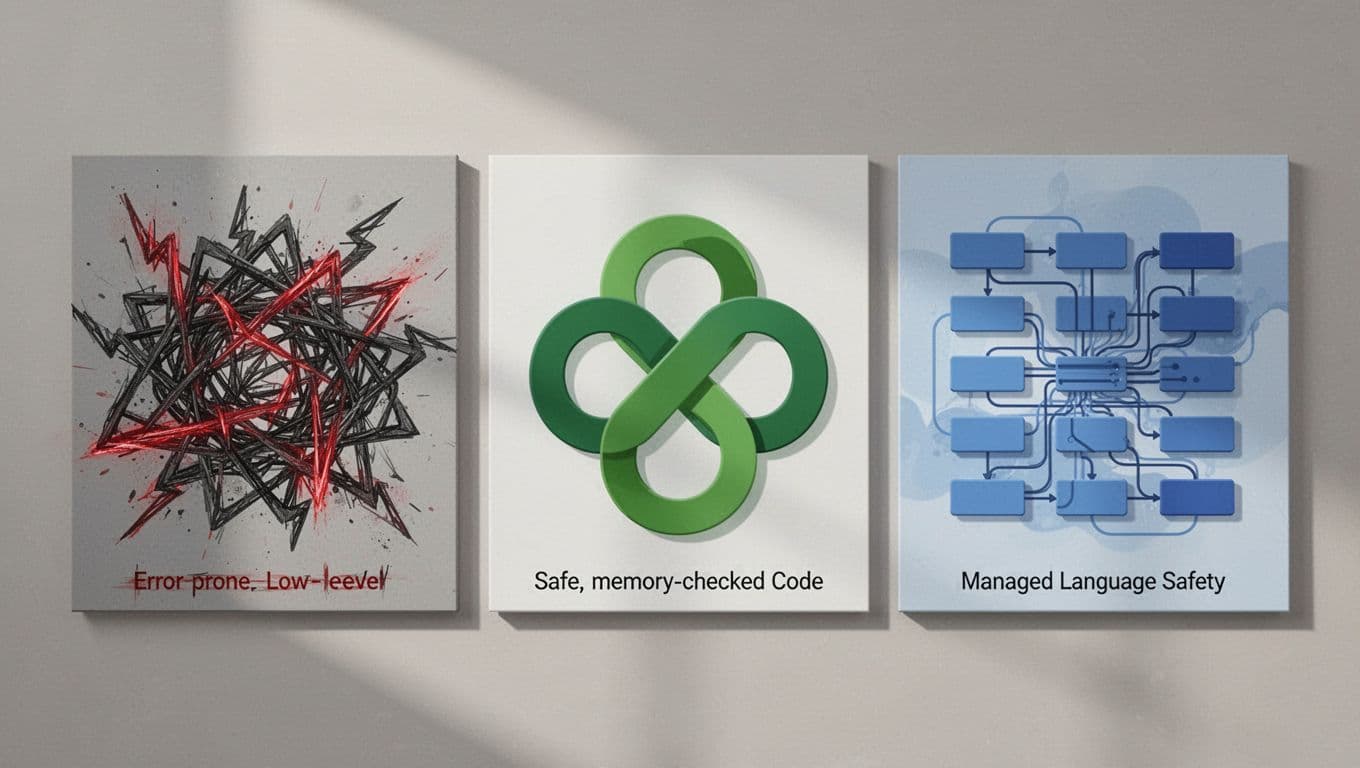
Hybrid wins in 2026. New code in Rust; legacy C++ hardened. FFI binds them safely.
Train accordingly. C++ devs learn Rust basics. All practice defensive C++.
Adoption stalls on rewrites cost. Focus training on patterns, not full switches.
Choose per need. Systems? Rust. Web? Managed.
Measure and Iterate Training Outcomes
Metrics prove value. Pre-training: Scan repo for memory CVEs. Post: Rescan.
Track defects. Vulns found in prod vs. dev. Aim for shift left.
Survey devs. Confidence scores on spotting bugs.
PR data: Time to fix memory issues. Checklist adoption rate.
Quarterly audits. Simulate attacks on sample code.
Adjust based on gaps. More fuzzing if runtime bugs persist.
Share wins. “Training cut escapes 40%.” Motivate teams.
Long-term: Certs or badges for completers. Ties to goals.
Iterate yearly. Update for new tools, threats.
Key Takeaways
Memory safety training builds secure code from day one. Hands-on exercises, tools like ASan, and checklists prevent most bugs. Mix languages wisely: harden C/C++, adopt Rust where it fits.
Your roadmap demands action. Start small, measure, scale. Teams that train regularly ship fewer vulns and gain buyer trust.
What bugs does your code still hide? Run a scan today.