table of contents
Your developers build powerful AI models every day. But without secure AI model training practices, those models risk data poisoning or leaked secrets. One bad dataset can embed backdoors that last through deployment.
In 2026, attacks on training pipelines hit enterprises hard. Security teams see it: poisoned data slips in, infrastructure gaps expose models. You need to equip your team fast.
This guide shows you how. Start with lifecycle risks, then build training paths, labs, checklists, and metrics. Your developers will handle secure training end-to-end.
Map Risks Across the AI Training Lifecycle
AI training spans data collection to deployment. Each stage holds unique threats. Attackers target datasets first because they shape the model.
Data handling comes early. Track provenance for every dataset. Use cryptographic signatures and timestamps to spot tampering. CISA outlines these steps in their AI data security best practices.
Labeling pipelines need validation too. Automated tools flag anomalies before data enters training. Without this, biases or poisons corrupt outputs.
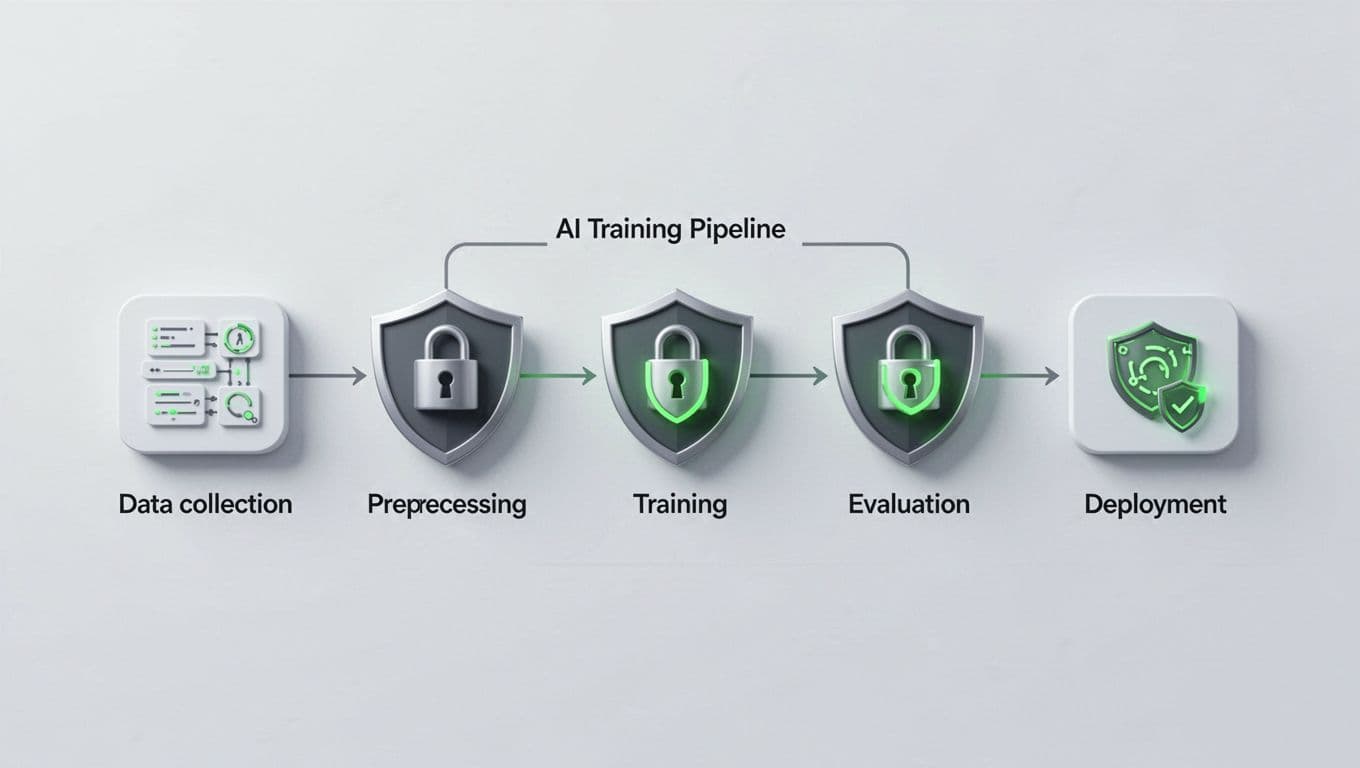
Next, training itself. Secret management prevents API keys from leaking into models. Tools like HashiCorp Vault inject secrets at runtime only. Infrastructure hardening follows: isolate clusters with least-privilege access.
Experiment tracking tools like MLflow must log securely. Sign model artifacts to verify integrity. RAND’s guide stresses securing high-risk AI models this way.
Dependency and container security matter. Scan with Trivy for vulnerabilities. Pin versions to avoid supply chain attacks.
CI/CD pipelines for ML demand scans at every commit. OWASP’s secure AI model ops cheat sheet covers input validation and rate limiting.
Monitor for training-time attacks. Real-time logs catch data drifts. Adversarial training builds resilience, as papers on data poisoning defenses explain.
Teach these risks first. Developers spot issues before they build.
Create Role-Based Learning Paths
Tailor training to roles. ML engineers focus on data pipelines. Security stakeholders learn monitoring.
Start juniors with basics: data provenance and secret scanning. Use short modules, 30 minutes each. Seniors dive into CI/CD hardening.
Mix formats. Videos explain concepts. Quizzes test recall. Paths last four weeks, two hours weekly.
For platform engineers, cover infrastructure. Teach Kubernetes pod security and network policies. Access control uses RBAC strictly.
DevSecOps teams get experiment tracking. Log hyperparameters immutably. Verify model hashes match expected values.
Track progress with badges. Leaders see completion rates. Adjust paths based on feedback.
This approach fits busy schedules. Developers apply lessons immediately.
Run Hands-On Labs for Real Defenses
Labs build muscle memory. Simulate attacks in safe sandboxes.
First lab: data poisoning. Teams ingest tainted datasets. They use validation scripts to detect and remove poisons. Tools like spectral signature analysis help.
Second: secret management. Developers train models with mock keys. Labs show leaks via model weights, then fix with Vault integration.

Third: CI/CD security. Build pipelines with Snyk scans. Students deploy vulnerable containers, then harden them.
Add model integrity checks. Sign artifacts with cosign. Verify in deployment gates.
Use cloud labs like AWS SageMaker or GCP Vertex AI. Free tiers work for small teams.
Run monthly. Rotate scenarios. Debriefs share fixes.
Developers leave confident. They defend against 2026 threats like adaptive poisons.
Use Checklists and Policies for Daily Wins
Checklists prevent slips. Make them team-wide.
Here’s a core one for training runs:
| Step | Action | Tool/Example |
|---|---|---|
| Data Prep | Verify provenance and scan for poisons | Custom scripts, dataset hashes |
| Secrets | No hardcodes; use managers | Vault, env injection |
| Dependencies | Pin versions, vulnerability scan | Poetry, Trivy |
| Infra | Least privilege, isolate pods | RBAC, network policies |
| Artifacts | Sign and log models | Cosign, MLflow |
| Monitor | Alert on drifts | Prometheus, anomaly detection |
Enforce via pre-commit hooks. Policies set rules: no unsigned models in prod.
Review quarterly. Update from threats like MITRE ATLAS.
These tools scale. Teams adopt fast.

Track Program Success with KPIs
Measure what matters. Completion rates hit 90% first.
Key metrics: poisoning detections per quarter. Aim for zero misses. Model integrity failures drop below 1%.
Survey developers: confidence scores rise 30%. Incident response time falls.
Audit logs show compliance. Tie to OKRs.
Refine based on data. Strong programs reduce risks enterprise-wide.
Key Takeaways
Secure AI model training protects your core assets. Focus on lifecycle risks, hands-on labs, checklists, and metrics.
Teams trained this way catch threats early. Models stay trustworthy.
Ready to strengthen your program? Book a Discovery Call with Bud Consulting for tailored advice.
Your developers handle secure training. Start today.